From Model Repositories to Machine Intelligence: Building an Interactive Analytics Architecture for AI Model Discovery

Hugging Face has made it much easier for developers to find and use pretrained machine-learning models. The problem is that once you start looking beyond a few well-known models, the number of choices becomes difficult to manage. Models differ in task, size, popularity, update history, and many other details, and there is no simple way to compare all of this information at once.
I wanted to see whether the repository itself could be treated as a dataset.
The first step was collecting model information through the Hugging Face Hub API. A Python script requests model records and extracts fields such as model ID, downloads, likes, pipeline task, creation and modification dates, ranking position, and parameter count when that information is available. The current implementation can retrieve thousands of records at a time rather than requiring models to be inspected individually.
Collecting the data turned out to be only part of the problem. Repository metadata is not always consistent. Some models have missing parameter counts, some fields are empty, and numerical values may need to be converted before they can be compared. A model with 800 million parameters, for example, should be represented on the same numerical scale as one with 7 billion parameters if the two are going to appear on the same chart.
The script therefore normalizes the records before storing them. Parameter counts are converted into common units, dates are placed into consistent formats, and missing values are handled explicitly rather than guessed. The cleaned records are then stored as JSON. To avoid damaging the active dataset if an update fails midway through, the program first writes the new data to a temporary file and replaces the old dataset only after the write succeeds.
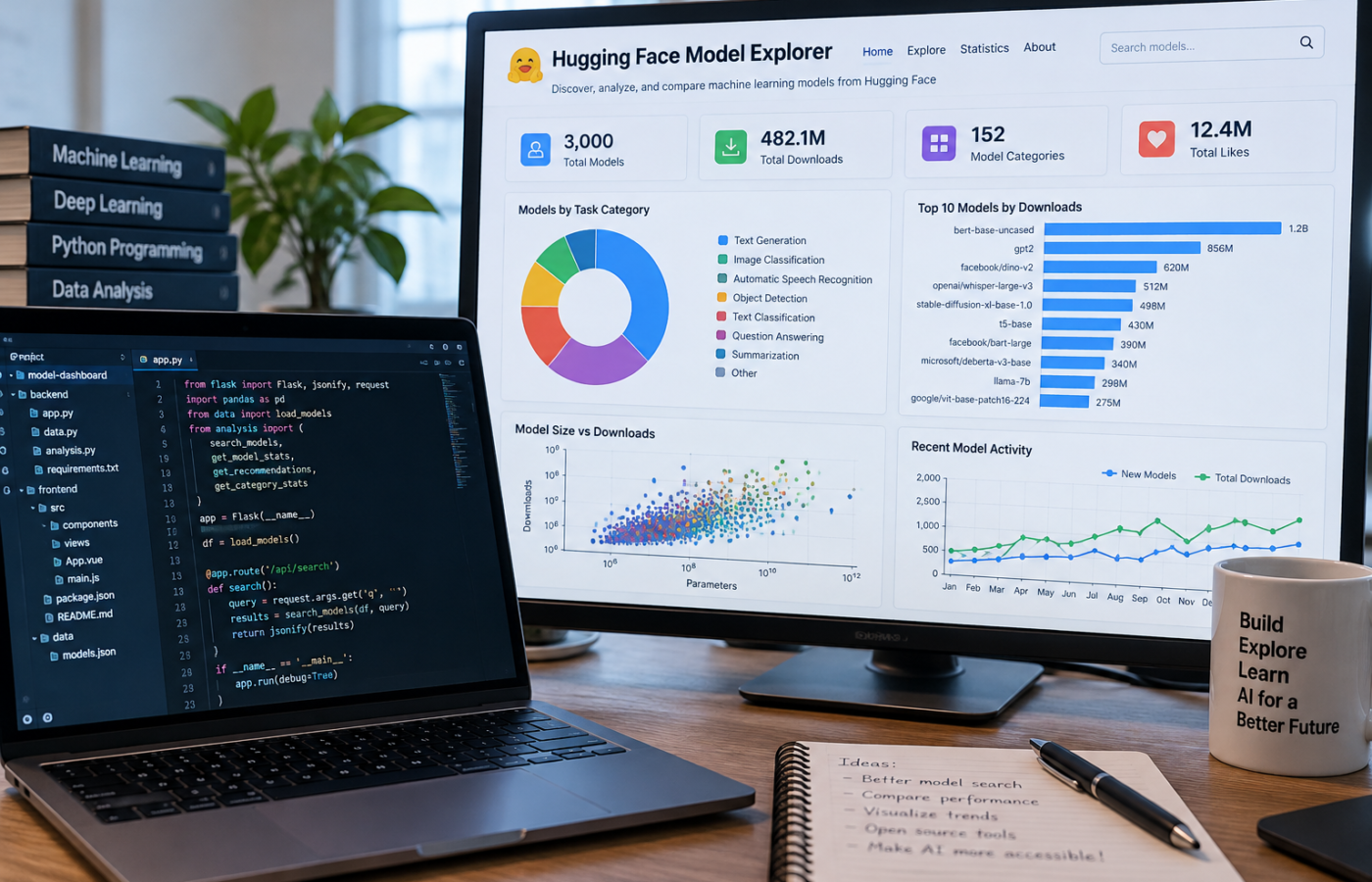
Once the dataset is prepared, a Flask backend loads it into Pandas and handles most of the analysis. The backend can search model names, identify the most downloaded models, count models by task category, compare model size with downloads, analyze activity over time, retrieve individual model information, and export the dataset as CSV.
One part I found particularly useful was the recommendation system. It is deliberately simple. When a user selects a model, the program first identifies its task category. It then finds other models in the same category, removes the selected model from the candidate set, ranks the remaining models by downloads, and returns the strongest matches.
This is not meant to be a sophisticated neural recommendation system. In fact, its simplicity is useful because the logic is easy to understand. If someone selects a text-generation model, the dashboard does not recommend an unrelated image-classification model simply because it happens to be popular.
The front end is built with Vue and communicates with Flask through Axios. ECharts turns the backend results into interactive visualizations. Users can see distributions of model types, download rankings, model-size-versus-download scatter plots, activity over time, and detailed information about individual models. Search results and recommendations connect directly to the same underlying dataset, so the different parts of the interface stay consistent.
What started as a dashboard project became more interesting once the components were separated. The Python script handles acquisition, the normalization layer prepares the data, Flask and Pandas handle analysis, and Vue and ECharts handle presentation. Because those parts are independent, the same approach could eventually be extended beyond Hugging Face to other model repositories by translating their metadata into a common format.
The larger lesson was that finding an AI model is becoming a data problem itself. As repositories continue to grow, developers may need tools that do more than list models. They will need ways to organize them, compare them, understand how they are being used, and narrow thousands of possibilities into a smaller set worth examining.
Z. Yang