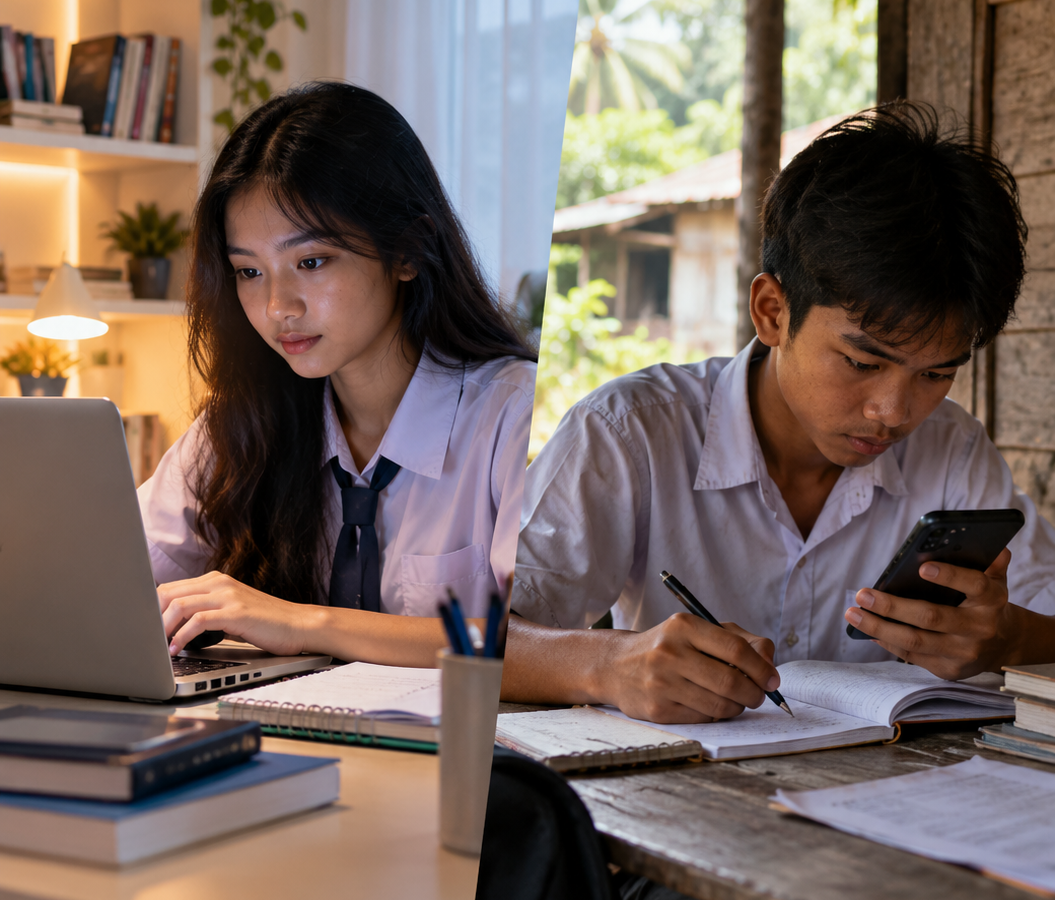
Digital Inequality and Access to Education

Digital Inequality and Access to Education
A Literature Review Research Paper
Prepared by:
Espinola, Vanechka Krzystof C.
Kim Donggeon
Nam Kyunggeun
Park Daniel
Gentry International School
October 2026
Abstract
Recently, digital technologies have become a central part of education, but not all students have equal opportunities to access and use them effectively. This literature review examined how digital inequality relates to access to education, with particular emphasis on the factors underlying unequal access, its effects on students’ learning, and resulting educational outcomes. Twenty academic and institutional sources, mainly published from 2013 to 2023, were identified through Google Scholar, ERIC, Scopus, and ScienceDirect using keywords such as “digital divide,” “digital inequality,” “technology access,” and “academic achievement.” The review was organized into four themes: digital inequality beyond internet access, unequal skills and unreliable access, the impact of the pandemic, and the limitations of device provision alone. Overall, the reviewed literature showed that digital inequality extends beyond access to devices and internet connections to include connection quality, digital skills, and educational support. The findings also suggested that providing devices alone may not be sufficient to improve academic outcomes. However, several research gaps were identified among the reviewed studies. Specifically, none examined the purposes of educational technology use and student–teacher communication together. In addition, senior high school students were not the primary focus of the included studies, and none of the reviewed studies specifically involved Philippine international-school students. These gaps indicate a need for future research on how technology use purposes and student-teacher communication may relate to the academic performance of senior high school students in the Philippine context.
Introduction (Daniel)
In recent decades, digital technologies, such as artificial intelligence, have been improving and have played a vital role in education. Sometimes a wide range of students heavily rely on smartphones, computers, and AI. However, students use these digital technologies to accomplish their assignments, attend online classes, and communicate with peers and teachers, which means that these technologies have made education to be more accessible and convenient by allowing students to obtain valuable information and educational resources unlike traditional classrooms. By contrast, not all students have opportunities to obtain a vast amount of information, creating an issue known as digital inequality.
Digital inequality refers to differences in access to digital technologies, digital skills, quality of internet connection, and the ability to use technology effectively (Robinson et al., 2017). These differences may be influenced by factors such as socioeconomic background, geographic location, previous technological experiences, and digital competence. In educational settings, such inequalities may affect students’ ability to access online resources, participate in learning activities, communicate with teachers, and complete academic requirements.
Addressing digital inequality is essential to ensuring that all students have equal opportunities to receive a quality education, regardless of their socioeconomic backgrounds or geographical locations. When students lack access to reliable internet connections and appropriate digital devices, they may experience disadvantages compared to those who have sufficient technological resources. Therefore, reducing digital inequality is important for promoting educational equity and ensuring students can benefit from the opportunities digital technologies provide.
This literature review aims to examine existing studies on digital inequality and its relationship to access to education. Specifically, it explores the major factors contributing to unequal access to digital technologies, investigates how these disparities affect students’ learning opportunities and academic experiences. It also discusses possible strategies to reduce the digital divide. To guide the review, the following research questions are needed to be addressed, 1) What are the main factors contributing to digital access and educational settings? 2) In what ways do disparities in digital access and skills influence students’ learning experiences and academic outcomes? 3) What strategies have been proposed or implemented to reduce digital inequality in education? By reviewing previous research, this literature review seeks to develop a better understanding of the challenges students face in accessing digital educational resources and the measures that may help create a more equitable learning environment.
Method of Literature Selection (Daniel)
To review the existing literature on digital inequality and its educational impact a systematic literature search was conducted. Sources were identified through electronic academic databases, including Google Scholar, ERIC, Scopus, and ScienceDirect. The search term used combinations of key words, such as: ‘digital divide’, ‘digital inequality’, ‘technology access’, ‘academic achievement’, ‘learning engagement’ and ‘K-12’.
Priority was given to peer-reviewed studies, and major institutional reports, which were published mainly from 2013 to 2023. Studies were included when they examined digital inequality, student-teacher communication, or educational outcomes, such as blogs, opinion articles, and non-academic sources were excluded. After applying these screening, the 20 academic and institutional sources were selected for the review.
Review of Related Literature (Van)
The studies reviewed in this paper were grouped into four themes: what digital inequality means, unequal skills and unreliable access, the effect of the COVID-19 pandemic, and whether giving students devices closes the gap.
Digital Inequality Is More Than Access to the Internet
Previous studies have conceptualized the divide as simply whether or not someone has a computer and internet connection, but that is an overly simple explanation. Robinson et al. (2015) argued that digital inequality should be understood as access, use, skills, and confidence in digital technologies, and taken as seriously as income, gender, or racial inequality. As well as information on who has a connection, reviews by Scheerder et al. (2017) and Lythreatis et al. (2022) identified three levels of the divide: access, skills and use, and the benefits of using the internet. Neither review found much research on the third level. Even in the Netherlands, where virtually everyone has an internet connection, van Deursen and van Dijk (2019) found obvious differences in the quality of devices and the costs of maintaining them, which in turn affected skills and usage. Dolan (2016) found something similar among K-12 students, noting that who has access to the internet tells us very little about how those students use the internet at home and in school.
Unequal Skills and Unreliable Access
A few recent studies show that low-income students have weaker digital skills. A meta-analysis of K-12 studies by Scherer and Siddiq (2019) found a small but statistically significant relationship between students’ family background and their ICT skills, although this gap was smaller than the gaps in math and reading. Ritzhaupt et al. (2013) tested 5,990 Florida middle schoolers and found higher ICT skills among students from better-off families. Other studies show that owning a device is not the same thing as reliable access. Gonzales et al. (2020) found that about one-in-five US college students reported broken devices, limited data plans, or poor connections, and students who used a poorly functioning laptop had lower grades. In rural Michigan, Hampton et al. (2021) found that students relying on a phone to access the internet scored lower on the SAT, while students with home broadband had higher levels of school engagement. Lembani et al. (2020) documented the same pattern among university distance learners in South Africa, where students taking the same course had very different experiences depending on where they lived. Together, these studies suggest that digital inequality involves not only device ownership but also digital skills and the quality and reliability of access.
The Pandemic Widened the Gap
These gaps became harder to ignore when schools were closed due to COVID-19. An estimated 31% of students globally were unable to access remote learning, the vast majority being poor or rural (GEM Report UNESCO, 2023). In Nigeria, Azubuike et al. (2021) showed private school students had significantly better access to digital devices than those in government schools, and that parental education affected the ability to help their children learn; in Spain, Bonal and González (2020) showed middle-class families maintained the quality of learning at home while poorer children suffered learning loss; while even in the Netherlands, which has strong internet coverage, Engzell et al. (2021) found a loss of about one-fifth of a school year of learning during 8 weeks of school closure, and up to a 60% larger loss among children from less-educated homes. Among college students in the US, Katz et al. (2021) show connection and device problems impeded students’ ability to learn from home, but having difficulty reaching teachers was most damaging to learning, while Mathrani et al. (2022) show that female students in 5 developing countries in South Asia faced greater disruption due to domestic work and gender roles.
Devices Alone Do Not Close the Gap
Several programs have attempted to bridge the gap by providing children with computers; unfortunately, the evidence shows that is not enough. In a random controlled trial in California, Fairlie and Robinson (2013) provided computers for free to students without one at home, and they increased computer use, but there was no effect on grades, achievement test scores, or attendance. A large 1 laptop per child program in rural Peru increased access but had no impact on students’ math or language scores (Cristia et al., 2017). The OECD (2015) found that computer access and use differed by students’ family background, gender, and location, and stressed that students first need strong basic reading and math skills. Tate and Warschauer (2022) outline how online learning requires a computer and an internet connection, the ability to learn independently, and teachers trained to teach online.
Discussion and Synthesis (Brian)
1) What are the main factors contributing to digital access and educational settings?
The digital divide is not just the ‘divide between Internet users and non-users’ (Robinson et al., 2015); it is the divide between access, use, skills and confidence (Robinson et al., 2015). Scheerder et al. (2017) and Lythreatis et al. (2022) describe three levels on which digital divide might manifest: access, skills and use and benefits, but the latter is least studied. Even when almost everyone is online, quality of devices and cost of maintenance still vary (van Deursen & van Dijk, 2019); broken devices, data caps and poor coverage can still limit students’ access (Gonzales et al., 2020). Socio-economic status and location also determine access and skills, with students from low socio-economic status showing weaker ICT skills (Ritzhaupt et al., 2013; Scherer & Siddiq, 2019) and rural students, who rely on a phone, at a disadvantage (Hampton et al., 2021). Access itself tells us very little about how students use technology (Dolan, 2016).
2) In what ways do disparities in digital access and skills influence students’ learning experiences and academic outcomes?
In general, students from low socio-economic backgrounds have weaker ICT skills, but the gap is less pronounced than in reading and maths (Ritzhaupt et al., 2013; Scherer & Siddiq, 2019). Having the device is not enough to access learning remotely at any time. Broken devices, limited data, and bad connections impacted the grades of college students (Gonzales et al., 2020), and students from rural areas who depended on their phones scored lower on the SAT (Hampton et al., 2021). The domicile of the students also affected their experience of a given course (Lembani et al., 2020). Taken together, these disparities shape both how students experience learning and how well they perform academically.
The Pandemic Widened the Gap
The Covid-19 closure revealed the fissures. Poor and rural students, almost by definition, were hard to reach (GEM Report UNESCO, 2023). Students in private schools in Nigeria had significantly improved access to remote learning devices as compared to students in government schools (Azubuike et al., 2021), and those from wealthier families continued learning at home better in Spain (Bonal & González, 2020). In the Netherlands, students experienced learning loss from the closure, with the most pronounced loss among students from less-educated households (Engzell et al., 2021). Difficulties reaching teachers delayed remote education for U.S. college students (Katz et al., 2021), and young women in South Asia were most affected because of increased family workload (Mathrani et al., 2022).
3) What strategies have been proposed or implemented to reduce digital inequality in education?
Computer distribution programs increased use of computers but not grades, test scores or attendance (Cristia et al., 2017; Fairlie & Robinson, 2013). The OECD (2015) highlighted that students must first have basic skills in reading and maths. Meanwhile, Tate and Warschauer (2022) suggest that online education requires independent learners and trained teachers. Taken together, these findings suggest that reducing digital inequality takes more than providing devices; it also requires building foundational skills and supporting both teachers and learners.
All of these studies seem to agree that digital inequality is no longer only a matter of possessing a computer or internet access. Today the digital divide manifests itself in the quality of devices and connections, in the digital literacy of students, as well as in the support they receive from teachers and parents (Lythreatis et al., 2022; van Deursen & van Dijk, 2019). The main demographics of students that are impacted are found in the research across countries and levels of education: socioeconomically disadvantaged households, rural communities and public schools (Azubuike et al., 2021; GEM Report UNESCO, 2023; Hampton et al., 2021).
The studies disagree on how much access alone helps. Poor access during the pandemic has been associated with direct learning losses (Engzell et al., 2021; Katz et al., 2021), but programs distributing computers alone did not lead to increases in test scores (Cristia et al., 2017; Fairlie & Robinson, 2013). This is consistent once access is viewed as necessary, but not sufficient. Computers only matter if students have the time, skills, and guidance to use them for learning (Tate & Warschauer, 2022). Some differences in findings can also be explained by what each study measured, with Hampton et al. (2021) finding home internet was associated with engagement but not strongly associated with grades, and Scherer and Siddiq (2019) finding the digital skills gap was smaller than the gap in math and reading.
From what the researchers have found, it’s not enough to buy gadgets to bridge the digital divide. Internet access, digital literacy, and teacher capacity are all critical. To close the gap, schools need to not only provide devices to students but also ensure that students have good internet connection and functioning devices, improve their digital literacy, and prepare teachers for online instruction and communication (Katz et al., 2021; Tate & Warschauer, 2022). Several articles focused on the US or Europe, so these aren’t always applicable to senior high school students in the Philippines.
Research Gap (EdK)
Previous studies have focused on physical device access and connectivity to measure the impact of the digital divide on student learning (Azubuike et al., 2021; Cristia et al., 2017; Fairlie & Robinson, 2013). However, among the reviewed studies, three gaps remain.
First, the reviewed literature suggests that the purposes for which students use digital technologies and student-teacher communication through digital technologies may be important to students’ educational experiences (Hampton et al., 2021; Katz et al., 2021; OECD, 2015). However, they appear in separate studies, and none of the reviewed studies examined them together.
Second, evidence on communication and remote learning, which refers to the education from not only inside the school but also outside the school, comes from university students (Katz et al., 2021), while studies of younger students focus on primary school (Cristia et al., 2017; Engzell et al., 2021) or grades 8-11 in rural U.S. (Hampton et al., 2021). Senior High School students, especially in the Philippines, are not a focus of any reviewed study.
Third, most of the reviewed studies come from the United States and Europe, with a few from Africa, South Asia, and Latin America, and none used Philippine samples or international school students. Therefore, our study aims to address these gaps by examining how technology-use purposes and student-teacher communication shape the academic performance of Senior High School students at Gentry International School in the Philippines. [1.1]None of the studies included in this review specifically examined senior high school students in a Philippine international school.
Therefore, a gap remains in understanding how technology-use purposes and student-teacher communication may relate together to the academic performance of senior high school students in the Philippine context.
Conclusion (Brian)[2.1]
The following research consistently reveals that digital disadvantage is not only related to whether a student owns a device or has an internet connection, but also to the quality of those resources, to student skills and the support from teachers and families (Lythreatis et al., 2022; van Deursen & van Dijk, 2019; Katz et al., 2021; Mathrani et al., 2022). These differences occur in many countries, and simply providing students with devices does not lead to higher achievement (Cristia et al., 2017; Fairlie & Robinson, 2013). Despite these findings, the literature also has gaps, as no study reported on technology-use purposes and student-teacher communication simultaneously, only a few focused on senior high school students, and none surveyed students from the Philippines or international schools. The digital divide also has the lowest use and benefits level (Scheerder et al., 2017; Lythreatis et al., 2022). Therefore, more context-specific research is needed to understand how students use technology and how they are using them to communicate with teachers. This study aims to connect this gap by exploring how functions of technology use and the communication skills between students and teachers influence Senior High School students’ academic performance at Gentry International School.
References
Azubuike, O. B., Adegboye, O., & Quadri, H. (2021). Who gets to learn in a pandemic? Exploring the digital divide in remote learning during the COVID-19 pandemic in Nigeria. International Journal of Educational Research Open, 2, Article 100022. https://doi.org/10.1016/j.ijedro.2020.100022
Bonal, X., & González, S. (2020). The impact of lockdown on the learning gap: Family and school divisions in times of crisis. International Review of Education, 66(5–6), 635–655. https://doi.org/10.1007/s11159-020-09860-z
Cristia, J., Ibarrarán, P., Cueto, S., Santiago, A., & Severín, E. (2017). Technology and child development: Evidence from the One Laptop per Child program. American Economic Journal: Applied Economics, 9(3), 295–320. https://doi.org/10.1257/app.20150385
Dolan, J. E. (2016). Splicing the divide: A review of research on the evolving digital divide among K–12 students. Journal of Research on Technology in Education, 48(1), 16–37. https://doi.org/10.1080/15391523.2015.1103147
Engzell, P., Frey, A., & Verhagen, M. D. (2021). Learning loss due to school closures during the COVID-19 pandemic. Proceedings of the National Academy of Sciences, 118(17), Article e2022376118. https://doi.org/10.1073/pnas.2022376118
Fairlie, R. W., & Robinson, J. (2013). Experimental evidence on the effects of home computers on academic achievement among schoolchildren. American Economic Journal: Applied Economics, 5(3), 211–240. https://doi.org/10.1257/app.5.3.211
GEM Report UNESCO. (2023). Global education monitoring report 2023: Technology in education: A tool on whose terms? UNESCO. https://doi.org/10.54676/UZQV8501
Gonzales, A. L., McCrory Calarco, J., & Lynch, T. (2020). Technology problems and student achievement gaps: A validation and extension of the technology maintenance construct. Communication Research, 47(5), 750–770. https://doi.org/10.1177/0093650218796366
Hampton, K. N., Robertson, C. T., Fernandez, L., Shin, I., & Bauer, J. M. (2021). How variation in internet access, digital skills, and media use are related to rural student outcomes: GPA, SAT, and educational aspirations. Telematics and Informatics, 63, Article 101666. https://doi.org/10.1016/j.tele.2021.101666
Katz, V. S., Jordan, A. B., & Ognyanova, K. (2021). Digital inequality, faculty communication, and remote learning experiences during the COVID-19 pandemic: A survey of U.S. undergraduates. PLOS ONE, 16(2), Article e0246641. https://doi.org/10.1371/journal.pone.0246641
Lembani, R., Gunter, A., Breines, M., & Dalu, M. T. B. (2020). The same course, different access: The digital divide between urban and rural distance education students in South Africa. Journal of Geography in Higher Education, 44(1), 70–84. https://doi.org/10.1080/03098265.2019.1694876
Lythreatis, S., Singh, S. K., & El-Kassar, A.-N. (2022). The digital divide: A review and future research agenda. Technological Forecasting and Social Change, 175, Article 121359. https://doi.org/10.1016/j.techfore.2021.121359
Mathrani, A., Sarvesh, T., & Umer, R. (2022). Digital divide framework: Online learning in developing countries during the COVID-19 lockdown. Globalisation, Societies and Education, 20(5), 625–640. https://doi.org/10.1080/14767724.2021.1981253
OECD. (2015). Students, computers and learning: Making the connection. OECD Publishing. https://doi.org/10.1787/9789264239555-en
Ritzhaupt, A. D., Liu, F., Dawson, K., & Barron, A. E. (2013). Differences in student information and communication technology literacy based on socio-economic status, ethnicity, and gender: Evidence of a digital divide in Florida schools. Journal of Research on Technology in Education, 45(4), 291–307. https://doi.org/10.1080/15391523.2013.10782607
Robinson, L., Cotten, S. R., Ono, H., Quan-Haase, A., Mesch, G., Chen, W., Schulz, J., Hale, T. M., & Stern, M. J. (2015). Digital inequalities and why they matter. Information, Communication & Society, 18(5), 569–582. https://doi.org/10.1080/1369118X.2015.1012532
Scheerder, A., van Deursen, A., & van Dijk, J. (2017). Determinants of Internet skills, uses and outcomes. A systematic review of the second- and third-level digital divide. Telematics and Informatics, 34(8), 1607–1624. https://doi.org/10.1016/j.tele.2017.07.007
Scherer, R., & Siddiq, F. (2019). The relation between students’ socioeconomic status and ICT literacy: Findings from a meta-analysis. Computers & Education, 138, 13–32. https://doi.org/10.1016/j.compedu.2019.04.011
Tate, T., & Warschauer, M. (2022). Equity in online learning. Educational Psychologist, 57(3), 192–206. https://doi.org/10.1080/00461520.2022.2062597
van Deursen, A. J. A. M., & van Dijk, J. A. G. M. (2019). The first-level digital divide shifts from inequalities in physical access to inequalities in material access. New Media & Society, 21(2), 354–375. https://doi.org/10.1177/1461444818797082